





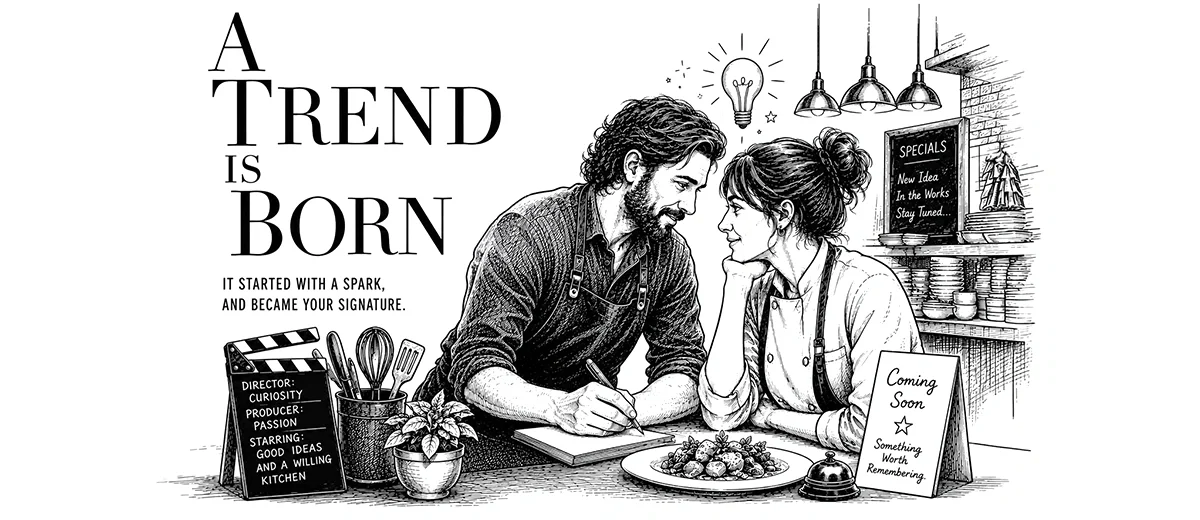
A Trend Is Born
By Luke LaBree 🔎
CMO, Dennis Food Service
It started with a spark, and became your signature.
Every year, just before the summer season gets underway, I start getting asked the same question. Usually it sounds something like: What’s trending? What are restaurants doing? What should operators be paying attention to?
It’s a reasonable question. Foodservice changes constantly, and there’s no shortage of people eager to tell you what the next big thing will be. Every week there’s a new report, a new prediction, a new flavor, a new technology that promises to reshape the industry. They’re all worth paying attention to, but they’re not where trends begin.
Every trend begins with noticing something. It might come from a conversation with a customer, a challenge in the kitchen, a new product, a better process, or something that just seemed worth trying. A trend is simply the proof that the idea worked.
The goal isn’t just recognizing trends. It’s paying attention to the thinking that created them. What caught their attention? What opportunity did they recognize? What made them imagine a better way?
Paying attention sounds simple, but it can be surprisingly difficult. Running a restaurant, convenience store, healthcare facility, school kitchen, or any foodservice operation requires an enormous amount of focus. There are deliveries to receive, schedules to build, inventory to manage, equipment to maintain, customers to serve, and a hundred other responsibilities competing for attention every day.
Some of the most valuable information in any business isn’t found in reports or industry publications. It’s hiding in plain sight — in the question customers keep asking, the menu item that consistently outsells expectations, the dish people photograph before they eat it, the drink servers can’t stop recommending, the request that keeps coming up, or the task your team wishes was easier. Those observations are often more valuable than industry forecasts because they’re specific to your customers, your operation, and your market.
Of course, paying attention doesn’t stop at your front door. While some opportunities reveal themselves inside your own business, others come from watching the broader foodservice world. New ingredients, labor-saving products, beverage programs, changing consumer preferences, and even what other operators are experimenting with all offer valuable insight. The goal isn’t to act on everything you notice. It’s to recognize what fits your customers, your operation, and the business you’re trying to build.
I think that’s one reason independent operators hold their own against competitors chasing the same customers. They’re close enough to their business to see things larger organizations often miss. A chain restaurant might need months of research, surveys, and meetings to identify a change in customer behavior. Independent operators have a front-row seat to the action. They notice what guests order, the special requests that keep coming up, and what people are still talking about as they head for the door.
Noticing something meaningful is only the beginning. The real value comes from asking, “What if?” and turning the answer into something new, interesting, and profitable.
Because noticing doesn’t build anything on its own. You have to try something. See how people respond. Refine it. Repeat it. That’s really all it takes—a small experiment that turns into something worth keeping. That’s where trends begin.
Summer hands you more customers, more transactions, and more opportunities to notice what’s working and what isn’t. But a strong season alone won’t build a better business. The things you try, the ideas you keep, and the changes that improve how you operate are the ones that last long after the season is over.
So pay attention to what catches your attention.