






We Choose To Say Yes
By Luke LaBree 🔎
CMO, Dennis Food Service
Big Turning Points Can Start with a Simple Answer
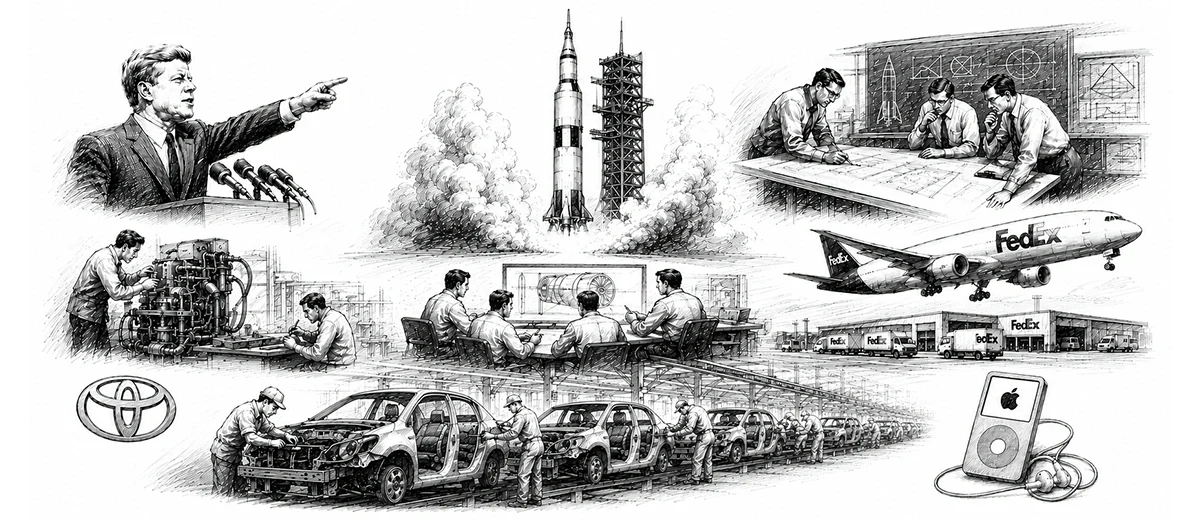
In 1962, President Kennedy publicly committed the United States to landing on the moon before anyone knew exactly how to do it. The technology didn’t fully exist yet. But once the country said yes, everything shifted. The question was no longer if — it was when. And from that moment, every problem became something to solve, every obstacle something to remove, every missing piece something to build. There was no way until one was made. One equation at a time. One engineering problem at a time. One solved obstacle at a time.
FedEx, Toyota, Apple, Netflix. Different industries, different decades, same instinct. Decide what the experience should feel like, then build backward from there. Shipping should be dependable. Production should flow. A thousand songs should fit in your pocket. A movie should be one click away. None of those things existed until someone decided they should.
Once people experience an easier way, they don’t go back. That’s not a technology story. It’s a human one.
There’s a certain satisfaction in an operation that runs the way you built it. You know your people. You know your product. You’ve solved the problems worth solving, probably more than once. But every business — no matter how well it runs — has moments where things slow down in ways that don’t have to.
A decade ago, there was far more guesswork built into everyday decisions. Customers called more often because information wasn’t always sitting in their pocket. Ordering online could be clunky or inconsistent. Menus were harder to keep updated across multiple places at once. Reservations happened almost entirely over the phone. People asked more questions because there were more gaps between one step and the next, and staff filled those gaps manually — through explanations, clarification, follow-up calls, and constant back-and-forth throughout the day.
Then smartphones, apps, GPS, mobile payments, online ordering, and real-time tracking started closing those gaps quickly. Entire industries reorganized themselves around speed, visibility, and removing unnecessary steps. Some things caught on immediately. Others took longer. QR codes are on of my favorite “small thing” examples — ignored for years, then everywhere all at once.
The small things are where yes lives. How many steps it takes to place an order. How clearly products are organized. How naturally an add-on fits the moment. How quickly a customer understands their options. Each one a small decision about whether to make something easier or leave it as it is.
Every big shift started the same way — someone looked at what was and decided it could be faster, easier, possible. Try saying yes before you’ve solved the problem, and trust that the how will follow. Look honestly at what’s between a customer and a decision. Between a staff member and the support they need. Between a good dish and the person it’s right for. Between man and the moon.